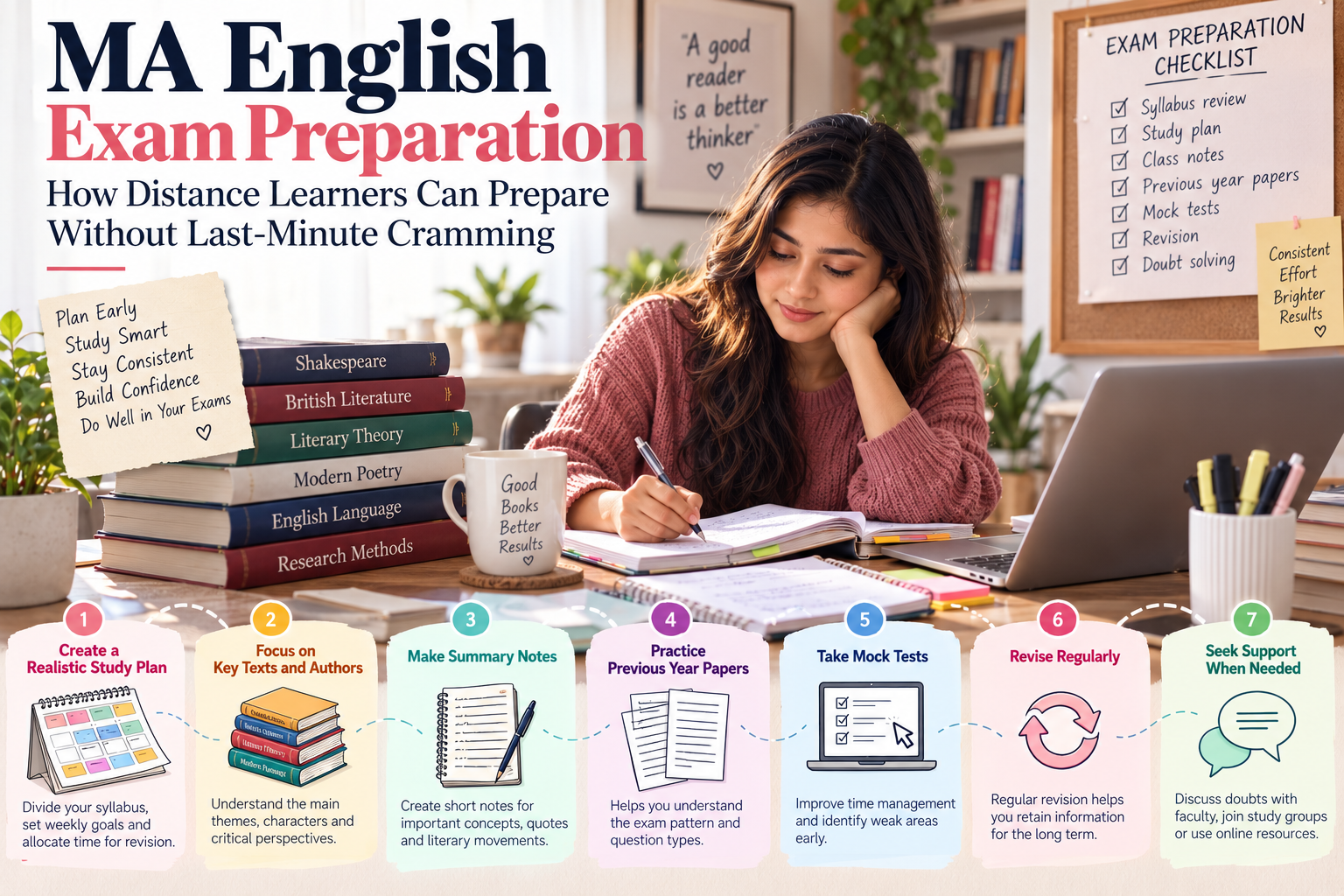
Distance learners in postgraduate English perform best when they spread preparation across the whole semester: reading primary texts early, building organised notes on themes, criticism and key quotations, practising written answers regularly and leaving the final weeks for revision rather than first reading. Literature examinations reward depth of understanding and well-structured argument, both of which take time to develop and cannot be built in a few nights.
A clear MA English study plan is the most effective safeguard against cramming. Because the syllabus spans several centuries of writing, multiple genres, linguistics and critical theory, a plan that divides the work into weekly targets turns an overwhelming reading list into manageable steps.
This guide explains why cramming fails in literature, introduces an original method for preparing each text, offers a semester schedule, gives paper-specific advice and addresses the particular situation of working and distance learners.
- Why Cramming Fails in Literature Examinations
- Understanding the Assessment Format
- The CANTO Method: Preparing Each Text Thoroughly
- Building a Semester Schedule
- Paper-by-Paper Preparation
- Learning Methods That Work for Literature
- Preparing as a Distance or Working Learner
- Choosing the Right Mode of Study
- Studying Online
- Combining Study with Work Experience
- Career Pathways for English Postgraduates
- Taking the Next Step
- Planning the Final Weeks Without Panic
- Frequently Asked Questions
Why Cramming Fails in Literature Examinations
Cramming relies on short-term memorisation, while literature examinations test interpretation, comparison and argument. Research on learning techniques supports this: a widely cited review by Dunlosky and colleagues rated practice testing and distributed practice, meaning study spread over time, as the most effective approaches, and rated rereading and highlighting as low in utility (Association for Psychological Science).
| Aspect | Last-minute cramming | Spaced preparation |
|---|---|---|
| Reading of primary texts | Summaries replace the actual texts | Texts are read fully and reread selectively |
| Understanding of criticism | Names and terms memorised without context | Critical views understood and applied to texts |
| Use of quotations | Few, often inaccurate | Well-chosen quotations recalled accurately |
| Answer quality | Descriptive and repetitive | Analytical, structured and comparative |
| Retention after the exam | Rapidly forgotten | Retained for later papers, UGC-NET and teaching |
| Stress level | High, with disrupted sleep | Moderate and manageable |
Understanding how to avoid last minute exam preparation begins with recognising that every postgraduate English paper builds on earlier reading. Texts studied in the first weeks of a semester become the foundation for comparison, contextual questions and critical analysis later.
Benefits of preparing early
- Time to read primary texts in full rather than relying on guides.
- Opportunity to connect texts across periods and genres.
- Better recall of quotations and critical arguments.
- Lower stress and better sleep during the examination period.
- Knowledge that remains useful for UGC-NET, research and teaching careers.
Understanding the Assessment Format
Preparation should match the way papers are assessed. In distance mode, assessment typically combines term-end written examinations with internal components such as assignments, projects or a term paper. For many open and distance programmes, term-end examinations are written papers conducted at designated centres.
What written literature papers usually require
- Long-answer essays that develop an argument about a text, theme or period.
- Short notes on authors, movements, literary terms or critical concepts.
- Reference-to-context questions that ask learners to identify and explain passages.
- Application questions in linguistics or criticism that require explaining concepts with examples.
Because many papers are handwritten, practising complete answers on paper within time limits is one of the most valuable forms of preparation, especially for learners who mainly type during daily work.
The CANTO Method: Preparing Each Text Thoroughly
The CANTO Method is an original framework for preparing literary texts for examination. It ensures that each text is studied from five angles that examiners commonly assess, and it produces a compact set of revision notes for every work on the syllabus.
| Step | Focus | What to prepare |
|---|---|---|
| C – Context | Period, author and background | Historical, social and literary context; the author’s major works and concerns |
| A – Arguments | Critical perspectives | Two or three critical views and how literary theories apply to the text |
| N – Notes on themes | Ideas, characters and form | Major themes, characters, narrative or poetic technique and structure |
| T – Textual evidence | Quotations | Six to ten short, accurate quotations linked to themes |
| O – Outline answers | Examination practice | Two or three essay outlines on likely questions, with one full timed answer |
Completing a CANTO sheet for each text soon after reading it means that revision becomes a matter of reviewing notes rather than starting afresh. Over a semester, these sheets form a complete revision resource for every paper.
Advantages of the CANTO Method
- Consistency: every text is prepared to the same standard.
- Exam alignment: the five steps match the components examiners reward.
- Compact revision: one or two pages per text replace bulky notes.
- Comparison-ready: organised notes make it easier to link texts across periods.
Building a Semester Schedule
An MA English exam study schedule works best when it follows the semester’s natural rhythm: reading early, analysis in the middle and revision at the end. The plan below assumes roughly 16 weeks before term-end examinations and can be adjusted to the actual academic calendar.
| Weeks | Phase | Main activities |
|---|---|---|
| 1–6 | Read | Read all primary texts in sequence; complete Context and Notes sections of each CANTO sheet |
| 7–10 | Analyse | Study criticism and theory; add Arguments and Textual evidence; submit assignments |
| 11–13 | Practise | Write essay outlines and timed answers; review previous years’ papers |
| 14–15 | Revise | Review CANTO sheets; memorise quotations; practise reference-to-context passages |
| 16 | Consolidate | Light review, rest and examination logistics |
The schedule is most effective when study time is spread across the week. Shorter, regular sessions of 45–90 minutes on most days retain far more than occasional long sessions.
Paper-by-Paper Preparation
Different components of the syllabus require different approaches. The table below sets out preparation priorities for common paper types in a postgraduate English programme.
| Paper type | Examples | Preparation priority |
|---|---|---|
| Period surveys | Chaucer to Milton; Restoration to 1798; Romantic Literature; Victorian Poetry | Chronology, movements and representative texts; comparison across authors |
| Single-author paper | Shakespeare | Close study of key plays, major speeches, themes and critical interpretations |
| Language and linguistics | English Linguistics and Phonetics | Regular practice of transcription and definitions with examples |
| Criticism and theory | Fundamentals of Literary Criticism; Literary Theories (Application) | Key critics, concepts and applying theories to familiar texts |
| Modern and global literatures | Twentieth Century British literature; American Literature; Indian Writing in English; New Literatures in English | Contexts of colonialism, modernism and identity; comparative themes |
| Research components | Research Methodology; Term Paper | Research design, citation styles and steady progress on written work |
Among the most useful MA English exam preparation tips is to treat linguistics and phonetics as a practice-based paper. Unlike literary papers, it rewards repeated exercises in transcription and analysis rather than reading alone.
Learning Methods That Work for Literature
Effective study techniques for literature combine active recall with written practice. The following approaches suit distance learners who study independently.
- Active recall: after each reading session, write down key ideas from memory before checking notes.
- Spaced review: revisit each CANTO sheet after a few days, then after a few weeks.
- Quotation flashcards: write a quotation on one side and its text, speaker and significance on the other.
- Timed writing: answer one essay question in 40–45 minutes at least once a week in the later phase.
- Comparative mapping: draw simple charts linking themes across texts and periods.
- Teaching aloud: explain a poem or critical concept to someone else to test understanding.
- Previous papers: study question patterns to identify recurring themes and formats.
Preparing as a Distance or Working Learner
Effective exam preparation for distance learning students depends on creating the structure that classroom programmes provide automatically. Without fixed lectures, learners need personal deadlines, regular routines and early contact with the university when questions arise.
Practical habits for distance learners
- Download all study material and the syllabus at the start of the semester.
- Set weekly reading targets based on the semester schedule.
- Keep assignment deadlines in a calendar and submit early.
- Join peer study groups or online forums to discuss texts.
- Use commutes and breaks for quotation flashcards and short readings.
- Request leave from work for examination days well in advance.
Importance of structure for working learners
- It prevents work pressure from pushing study into the final weeks.
- It makes limited study hours more productive.
- It ensures internal assessments, which contribute to final results, are completed on time.
- It reduces stress and protects health during demanding periods.
Choosing the Right Mode of Study
The postgraduate English programme is offered in three modes, each with the same core curriculum but suited to different circumstances. Choosing the right mode affects how preparation fits around work and other commitments.
Study literature on a schedule that fits real life. The Distance MA English programme combines a comprehensive syllabus with the flexibility of open and distance learning.
Distance mode at a glance
- Duration: two years across four semesters.
- Core curriculum: Chaucer to Milton, Shakespeare, Literary Criticism, Linguistics and Phonetics, Romantic and Victorian literature, American Literature, twentieth-century British literature, Research Methodology, Indian Aesthetics, Indian Writing in English and New Literatures in English.
- Assessment: term-end written examinations at designated centres, with assignments and a term paper.
- Eligibility: a bachelor’s degree with English as a main subject and 50% aggregate, among other routes, with relaxation for SC/ST candidates.
Studying Online
Learners who prefer digital delivery can follow the same syllabus in online mode, which UGC regulations treat as equivalent to a regular degree.
Bring literature, language and theory to any screen. The MA English Online programme offers the full postgraduate syllabus in a flexible online format.
Online mode at a glance
- Duration: two years.
- Curriculum: the same four-semester syllabus, including an elective choice between World Literature in Translation and Literary Theories (Application).
- Internal assessment: a term paper in the final semester.
- Suited to: learners comfortable with digital study who want structured online access to the programme.
Combining Study with Work Experience
For learners who want practical exposure alongside their degree, an internship-based route connects literary study with real workplaces.
Turn literary knowledge into professional experience before graduation. The MA English Internship programme pairs the full syllabus with onsite work-based learning.
Internship route at a glance
- Duration: two years, combining distance learning with internship-based learning.
- Internship settings: publishing houses, schools, media companies and content firms.
- Curriculum: the same core syllabus as the other modes.
- Suited to: learners seeking practical experience for careers in publishing, media, content or education.
Career Pathways for English Postgraduates
Steady preparation builds knowledge that continues to matter well beyond examinations, particularly for careers that depend on reading, writing and critical thinking.
| Field | Job roles |
|---|---|
| Education | Lecturer or assistant professor (after UGC-NET), curriculum designer, language trainer |
| Writing and editing | Content writer, editor, creative writer, publishing professional |
| Language services | Translator, localisation specialist |
| Media and communication | Journalist, public relations officer, corporate communication specialist |
| Research | Researcher in literature and culture, research associate, PhD scholar |
Knowledge built steadily during the programme also supports UGC-NET preparation, where a broad and well-retained understanding of literary history and criticism is essential.
Taking the Next Step
Learners considering postgraduate study, or other programmes in open and distance mode, can review admission details and the full range of options before applying.
A well-planned degree starts with a well-informed admission. Visit CCSU ODL Admission to review programmes, admission updates and application steps.
Other open and distance learning programmes available
- Undergraduate: BA and BBA.
- Master of Arts: Education, Economics, Sociology, Political Science and History, alongside English.
- Commerce and management: M.Com and MBA in Marketing, HR or Finance.
- Computer applications: MCA.
Planning the Final Weeks Without Panic
Knowing how to prepare for MA English exams in the final month is largely about consolidation. If the semester schedule has been followed, the last weeks focus on reviewing CANTO sheets, practising timed answers and protecting rest.
Final-month checklist
- Review one CANTO sheet per text, focusing on themes and quotations.
- Write at least one timed answer for each paper.
- Practise reference-to-context passages from major texts.
- Revise key definitions and examples for linguistics and criticism.
- Confirm examination dates, centre, and admit card details.
- Maintain regular sleep and meals.
Frequently Asked Questions
If time is genuinely short, the most efficient approach is to focus on high-weight topics, test yourself with questions rather than rereading, review key quotations and concepts in short bursts, and sleep before the examination. Cramming can help in an emergency, but material learned this way is quickly forgotten, so steady preparation remains far more effective.
Prioritise the most frequently examined topics, use active recall by writing answers from memory, review summary notes rather than full texts, practise one or two timed answers and avoid staying up all night, as sleep is essential for memory and concentration.
Preparation should begin at the start of the semester with reading the primary texts. Focused revision should start at least four to six weeks before term-end examinations, leaving the final weeks for timed practice and review.
Working students can set weekly reading targets, study in short daily sessions, use commutes for quotation flashcards and short readings, complete assignments early, join study groups and request leave from work for examination days in advance.
Common mistakes include relying only on summaries instead of reading texts, memorising critical names without understanding them, neglecting quotations, ignoring linguistics practice, skipping timed written answers, leaving internal assessments late and cramming in the final week.